
HEALTHWISE COLUMN
Hidden in Plain Sight – Two Ways to See the World
March 13, 2026
By Dr. Davidicus Wong
Healthwise is a monthly column by Burnaby family doctor Dr. Davidicus Wong, presented by the Burnaby Primary Care Network in partnership with the Burnaby Division of Family Practice. In this article, Dr. Wong reflects on how we continue to change throughout our lives, and how intentions shape who we become over time.
You need not complete a pilgrimage to the Sistine Chapel to be inspired by the beauty of Michelangelo’s ceiling frescos and the artist’s clue to the source of our suffering and its solution.
Hidden in plain sight in the central panel depicting “God Creating Man” is an anatomically accurate cross section of the human brain, and in the sweep of the Divine being’s left arm and garment is the corpus callosum, the structure that connects the right cerebral hemisphere from the left.
I don’t think Michelangelo was simply showing off his secret knowledge gained from clandestine anatomical studies nor do I believe that he was simply saying that the Divine graced humans with the gifts of life and the thinking brain.
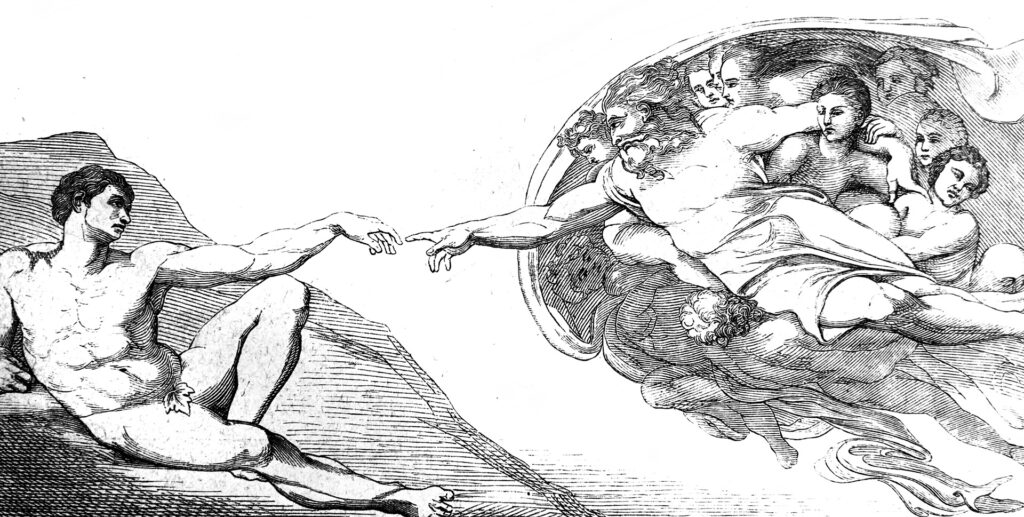
I see in this metaphor an insight into how the structure and function of our physical brains shape and constrain our thinking and limit our awareness of reality and our very identities.
Each of us has a brain divided into two hemispheres, the right and the left. It’s not as if we have two separate brains for redundancy or spare parts just as we have two kidneys and Klingons have two hearts in case of injury in battle or an altruistic donation to another person in need.
Though the cerebral hemispheres share many functions, there are some that are predominantly unilateral.
Many non-scientists are aware that the sensory and motor cortices of each cerebral hemisphere communicate with the opposite side of the body. Visual input from the left field of vision is received and processed in the right occipital lobe. The motor cortex of the left brain controls movement of the right side of the body. The sensations you feel in your right palm are received by the left sensory cortex.
There are some cognitive functions very specific to one cerebral hemisphere. A notable example is Broca’s area, a region in the left cerebral hemisphere responsible for language processing. There is no corresponding area in the oppositive hemisphere. (In natural lefthanders, the speech centre is usually located in the right cerebral hemisphere.)
Our unique cerebral hemispheres have been associated with two distinct modes of thinking or making sense of the world. The left hemisphere favours a dualistic interpretation of reality. It discriminates differences, compares, categorizes and judges. It is linear and logical. It lives in a world of concepts and distinctions: black and white, me vs others, us vs them.
Unless you are a monk or an artist, it is the left side of your brain that is front and centre at school and work and likely working overtime at home.
The right cerebral hemisphere has a more holistic view of human experience. It is more experiential than conceptual. It thinks in metaphoric stories rather than in linear logic. It is more intuitive, more accepting and more connected.
The specialized functions of our cerebral hemispheres evolved and persist today because of the survival value of both modes of seeing the world.
The watchful, judging and comparing left hemisphere is sensitive to danger and fosters goal-setting. It has helped individuals to survive and get important things done.
The holistic, connected perspective of the right cerebral hemisphere brought us together to care for and cooperate with one another. We feel not alone and separate but connected. We care and feel cared for. We experience the peace and joy of being a part of the greater whole.
In his tome, “The Master and His Emissary: the Divided Brain and the Making of Western World”, Iain McGilchrist presented a compelling metaphor that reflects the problems of modern society. While we need a balance of the two modes of thinking about ourselves and the world that we share, the conceptual, dualistic perspective predominates and with this world- and self-views that separate us from one another, seeing threatening enemies in those whom we perceive as different and competing political groups and nations.
In that same central fresco of the Sistine Chapel, the fingers of God and man almost touch. The finger of God reaches out vigorously to connect, yet a gap is created by the finger of man flexed back still drawn back into his separate concept of the self.
In his book, “What Happens in Mindfulness: Inner Awakening and Embodied Consciousness”, John Teasdale refers to McGilchrist’s work and describes his own theory of two cognitive subsystems corresponding to the modes of perception of the two cerebral hemispheres. He explains how mindfulness practice actually works in fostering the qualities and holistic perspective of the right cerebral hemisphere.
I teach mindfulness practices to my own patients to foster the perspectives of compassion, unconditional love, equanimity/peace and joy/flow. We need to remind ourselves that we are more than our left brains think we are. We are part of a greater whole. We love and are loved just as we are. We are better together.
Within each of us is the love, peace and joy that we long for. We each have a role in fostering greater love, peace and happiness in our world.
In upcoming columns, I will share practical ways to foster greater mindfulness in your daily life.
Visit us online monthly for new writing by Dr. Davidicus Wong, or sign up for email updates so you never miss a Healthwise article or an Empowering Patients talk!

About Dr. Davidicus Wong
Dr. Davidicus Wong is a family physician at the PrimeCare Medical Centre. His Healthwise column appeared regularly in the Burnaby Now for over two decades. Now he delivers his monthly wisdom to you via the Burnaby Primary Care Network! You can read more about achieving your positive potential for health at davidicuswong.wordpress.com.